Showing posts with label fieldtrip. Show all posts

Wednesday, April 13, 2011

Underground Mines Galore


Fields and acres of short yellow flowers covered the lower cow pocked hillsides as we headed North and East towards the Montezuma gold mining district. Higher up the mountain, light swirls and dustings of Styrofoam sleet balls sprinkled my hair as we searched, a biting chill wind testing my bones, but not quite enough falling ice to actually accumulate on the ground. We've taken this road to Montezuma many times before, but we have yet to explore all the region has to offer.


Along one dirt road, car sized blocks of pure glistening white marble can easily be seen. This area was once mined for marble but now only crumbling blocks of cement foundations remain in places where the marble blocks were once slid along cables to the main road.


In this same area, we often find small garnets. Recently, Dave found a nice pocket of large garnets and aquamarines, but this area is fickle. You might find a decent pocket right away or you might dig for hours and days and not find another. Today, we found very little other than a few very small garnets, one of which you can see in the photo.


Driving along one of the smaller brush covered paths, Dave also found a very large boulder hidden among the weeds which managed to apply a very large dent to the right underside of his jeep, just under the passenger side door. It also tore off a chunk of plastic moulding that was left to dangle precariously. But the damage looked to be all aesthetic, so we pressed on through the high shrubs.


Later in the day, the sun broke through the clouds, dissipating the sleet, and we drove to an area where many old gold mine tunnels can be found. And we were sure to explore as many as we could. The first one was entirely flooded, the water actually spilling out along the road and into a small river. We surmised that the excavation there probably opened a small spring that may run all year around, feeding the river beside it.

However, other mine entrances were higher and drier. In the photo, you can see Dave inspecting a large vein of white quartz inside one of the mine tunnels and in another photo, you can see a closeup of one tiny gold nugget present right there in the mine wall quartz (click on photo for larger view). Yes, squint very hard, it's that tiny speck! As often happens, the gold was present in areas of white quartz that had heavy iron staining (that reddish color on the quartz) and also dark almost bluish staining that indicates presence of other metals. Dave did his best to collect what nuggets he saw and those that did not accidentally fall onto the mine floor and become lost with the other dirt and rock have ended up in a small baggie for later inspection.

Many of the mines have preexisting denizens like rats that weave large nests from dried grasses, and bats that cling onto the walls and ceiling waiting for dusk to start their activities. As I zoomed in for a photo of one of the bats, my head brushing against the ceiling as I did so, I suddenly felt a small tickle on my ear and I jumped back, only to realize it was just Dave tickling my ear and not an actual bat. He was trying to mess with me and I guess he succeeded!

Bare in mind that all of these mine tunnels were pitch black inside. We all had small flashlights but for the most part, I could see very little. In order to take photos, I would just point and click and only later find out what showed up in the flash of light generated by the camera flash. Therefore, I was rather surprised in one flash photo to see that Sesame Pooch had turned into a glowing demon eyed chupacabra dog! But I guess she needed those x ray eyes to so blithely stroll around inside the mines with us, even though any other smart and sane dog would have had common sense enough to wait outside instead. I would have been nervous of her potentially falling into a vertical shaft, but some of us had been in these mines some years earlier, so we knew there were no dangerous drop offs present.

In the demon dog mine, the camera also found many orbs which are round circle things that seem to float in the air and usually only show up in camera photos. Orbs are either specks of dust or evidence of ghosts, depending on who you ask, but for whatever reason, there were hundreds of orbs in almost all photos from that one demon dog mine, but none appeared in any photos from any of the other mines. You can see some of the orbs in the demon dog photo.

Overall, the day was fun and the scenery beautiful. I even enjoyed the sleet as, being a California girl, I see such a thing only very rarely, and it did not interfere with our rock hunt. However, we did not find much take home rock this day. I guess I will just have to instead work on the tons I already have in my front yard!

Friday, April 8, 2011

Mooralla, Australia Smokey Quartz Fieldtrip

[Note: This article was reprinted with permission from the author, Bob Jackson of Geology Adventures.]

Some folks would say youʼd have to be mad to travel half way around the world to collect quartz crystals. I am crazy for quartz, particularly when the specimens in question are smoky quartz from Mooralla, Australia. Perhaps those same folks would say I could have ended the previous sentence after the 3rd word, but those folks would not be mineral collectors. Mooralla smoky quartz crystals are unique in the world. They somewhat resemble “Herkimer diamonds”, being doubly-terminated, extremely lustrous,and equidimensional.

The flight from Seattle to LA to Melbourne is long, but the November skies were smooth,and I managed to sleep for half of the LA-Australia leg, which departs LA late evening. This was my 12th visit in 20 years, so I knew what to expect. My last flight there was on United, which seemed to have had its seats designed by a pickle-packer, so I took my chances with a new airline, VAustralia, the newest of Bransonʼs Virgin-clones, and was pleasantly surprised. Arriving relatively refreshed, I gathered my bags and caught a bus to Ballarat, the eastern-most point of the Aussie Golden Triangle, the equivalent of Californiaʼs Mother Lode country. My old friend Doug met me there with his ʻuteʼ (pickup truck) for the 3 hour drive to Mooralla.

Mooralla is the name of a station, the Aussie equivalent of a ranch. The original station comprised over a thousand acres, but the digging area is set aside as a public ʻfossickingʼ (rockhounding) area. Australiaʼs mining laws are quite different than our US laws. All mineral rights are held by the government, including those on private land. The original station owner of Mooralla found smoky quartz crystals on the surface while tending sheep, and told a neighbor, who filed a mining claim on it. Claims of interest to fossickers can be turned into permanent public collecting areas, which is what happened at Mooralla. So this formerly private land is now set aside for fossicking and is one of the Aussie destinations for rockhounding tours led by yours truly for GeologyAdventures.com.

Our camp is in the bush, about an hour south of the nearest country town, so once there, we settle in for a month. My tour business causes me to spend about a third of every year camping out ... Mooralla is a most comfortable camp. I reside in a tent, Doug has a trailer outfitted with frig and freezer, so on our way in we fill the ute with frozen food and beer. Evenings at Mooralla are sublime: dinner cooked on the barbie, collectors cooked by the sun cooling off with a cold one, hot water for a shower warming in a bucket, kookaburras laughing and cockatoos scolding as the sun sets behind gum trees.

Doug arrived at Mooralla a week before I did, and had set up camp and gotten a hole started. The hole-starting process involves putting up a 20 X 20 ft. tarp, for sun and rain protection, and slicing chunks of clay out of a 10 X 10 foot surface.

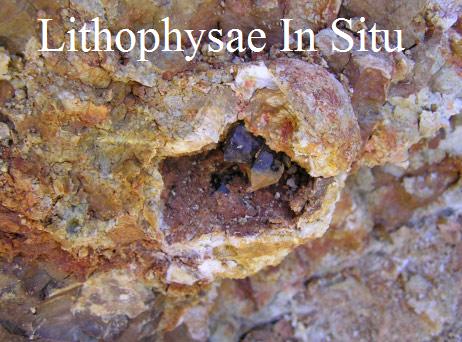
The clay is derived from an Eocene rhyolite flow. Over the past 40-odd million years, the rhyolite has decomposed to clay. The smoky quartz crystals formed in lithophysae, aka: thundereggs. The clay shows the sub-horizontal banding of the original rhyolite, and varies from a moist, elastic, dense medium that sticks to your shovel, to a hard adobe like substance. Depending on recent rainfall, the hole starting process can take from a day to a week.

Once you dig through the surface clay, the material becomes more uniform. About 5 ft. down is a red clay zone that marks the beginning of the lithophysae-bearing area. Fossicking areas require that only hand tools be used, so we set up a hand-powered rope windlass to haul the muck out of our hole. As the hole deepens, more time is required to remove each round of waste. In a week we were down 10 ft; by the end of the second week, 16 ft. Muck leaves the hole by windlass. An hourʼs digging in a 10 X 10 ft. hole requires 20 minutes of hoisting buckets.

As we continued down, we encountered layers where lithophysae were abundant. Collecting crystals is a lot slower than digging clay, so our downward progress slowed. The third week we only dug 4 ft. of muck, but produced over a thousand crystals. Every evening we cleaned our daily take of ʻeggsʼ, at least enough to judge the quality of the crystals found.

During our third week, we struck a layer of large eggs, up to a foot in diameter. Eggs this large are uncommon at Mooralla. In the photo, you can see the normal-sized
eggs (+/- 3 inches) in the pink clay band above, with the larger eggs below in the grey clay horizon. The pick head is 10 inches. At least 50% of the smokies are double terminated. Fast growth (vapor phase) caused frequent inclusions and enhydros to form within the crystals.

It is hard to imagine how the crystals formed in these lithophysae, as they are so densely packed there is little room for the clay. Almost every egg, even tiny ones, will have at least one smoky, usually sitting on a bed of small, clear quartz druse. Larger eggs will contain multiple plates of smokies attached to thin shells of silicified rhyolite. Opening a large egg is like peeling an onion.

That week I returned to Melbourne to pick up a group of visitors from the U.S. & Canada; they had the experience of digging out one egg after another. When the eggs are widely separated, it is easy to pop them out with a deft swing of a pick, but when they are tightly packed, much delicate work is required to avoid damaging the crystals.

During our 4th week, the rainy system that had caused floods in Queensland reached Victoria. Working the hole in the rain is normally no problem, as the large tarp shunts the water away from the hole. Walking between camp and the hole can be an adventure, as the clay ground surface is extremely slick, and your boots quickly accumulate many pounds and inches of gooey clay.

After 3 days of nearly-continual rain, we decided that maybe a visit to town was in order. The access to the locality requires fording two creeks, normally dry in November. The first time I looked, there were 6 inches of water in the creek. The second time, 2 hours later, the creek was 18 inches deep and moving quickly. Since my flight home was scheduled later that week, it seemed a good idea to make a run to town. Was glad we did, as 2 days later our camp area was submerged. The zone in the bottom of the hole was encouraging, weʼll return to dig it back out another year.
-Bob Jackson

Saturday, March 26, 2011

The Searchers at Chuckwalla Springs Day 3


On day three, we decided to take an easier and safer road to an area known for saginite. Saginite is more of a morphological term than a geological one. Saginite is basically a word that described when a rock contains a spray or fan shaped array of needle like structures that often look very striking. In fact, the word is vague enough that opinions vary on exactly what does and does not constitute saginite, but this location had the classic looking golden or black needles in clear or white agate. One piece I found even had some black needles mixed with back spots in white agate with white spots and some clear areas (photo 1). Very interesting! But at first, I had to admit I couldn't find a darned thing.

The good saginite agate at that location looks much the same as the nodules that contain no saginite, and most of all of them have a lot of desert varnish and black stuff on the outside, such that you can't really see what is inside unless you break them. See the blah looking exterior of the rough saginite in photo 2. But since the nodules are small, you don't really want to crack them in half either. However, sometimes you can just barely see the fan shape of the saginite on the outside of the rock as well (photo 3).

Eventually, I wandered further from the main site and found some veins of white and clear plume. A few pieces had red centers that were very striking but I couldn't find the source for those. Everything seemed almost randomly scattered and fickle veins changed colors and pinched in and out erratically. At one point, one of our party called us over and showed us where she had found a very large desert tortoise that seemed only slightly irritated at our arrival, and then just a short distance away, she found a much smaller baby desert tortoise smaller than my fist. Of course, I had to have pictures of both! (photos 4 and 5) Finally, we heard the leader of the group calling us back as we were the farthest out. They were already heading back to the trucks and we needed to leave as well.


Walking back out, one of our group fell and gouged her elbow on the ground only a short distance from the truck. Solicitously, Jay Valle, our driver, volunteered to fish out some nice clean band aids for her to stem the bleeding from the cut. No sooner had he popped open the tin of band aids than did we see a mummified lizard skeleton on the very top if it! (see photo 6) Only a rock hound would think to store a pristine skeleton there on top of the band aids and then forget about it and leave it for months! Luckily, band aids come sealed in their own wrapping and we all had a good laugh at the sudden appearance of the skeleton in such an improbable location.

The next stop was actually just along the road going back. Some years ago, some of us had been working with poor directions and had been unable to find what we were looking for, but we did instead accidentally stumble upon a tall outcrop of white quartz stained with copper ore. Now we would lead the others to that site and many of us were soon busily clambering around on the outcrop and picking and chiseling away at the white and blue walls of quartz. (photos 7 through 11)

One of us experienced with gold hunting said the rock was probably originally investigated for gold because copper and quartz are both indicators of possible gold presence. Many jokes about finding gold nuggets were then bantered around but not surprisingly, no actual gold was found. There were rumors of an abandoned crumbled stone cabin somewhere near and we also found an old abandoned car with thousands of bullet holes in it, which also made for a nice picture.


From that location, the rest of the campers took the nice easy gravel road back to camp. They had to leave that night and so wanted an early start, but we weren't leaving until Monday morning so we opted to go back to the saginite location for further exploration. Our legs were now getting tired, but that did not stop us from walking over many hills and ravines to scout for agate anywhere we could find. Most of the region had no rock of interest but in a few places with did find more agate seams, some with interesting plumes and shapes. And I found some nice Drusy, most of it white and clean already so that I will not have to remove any staining in order to make it look good.


We ended our walk by cutting back through the main traditional saginite collecting area and towards the end of it, I suddenly began finding saginite. Perhaps I had finally gotten the eye for it, but also it seemed I was suddenly in a very productive 10 foot diameter region that had lots of pieces. Almost every nodule I picked up looked to have some saginite and we both stopped and scoured that area. Once having thoroughly checked that area and moving slightly further away, I only found one other piece and after a consider time of fruitless continued searching we had enough and continued back to the truck. I had a pocketful of small agate nodules and hopefully many will contain saginite, but I won't know for sure until I polish some corners so I can see inside of them. The day had been good but they sky was darkening.

We went into Blythe for a steak dinner and then returned to camp to burn the rest of the firewood. That night, the wind picked and light rain fell in the morning hours. But it stopped at sunrise and were able to pack and leave in comfort.

It was time to say goodbye for now to the blooming flower fields of the desert in springtime, sharp red ocotillo flowers pointing skyward. Another wonderful adventure came to a pleasant conclusion and now I can't wait to cut and polish my new treasures!

Day 1 here: Rockchaser: The Searchers at Chuckwalla Springs Day 1
Day 2 here: Rockchaser: The Searchers at Chuckwalla Springs Day 2

Wednesday, March 23, 2011

The Searchers at Chuckwalla Springs Day 2


The next day, the trucks assembled and headed out to the first location, which was an old abandoned gold mining area that contained a number of decaying structures (photos 1 and 2). Some of the parts of the structures had been cannibalized by metal recyclers and other parts lay strewn on the ground. Around the area were also many small agate nodules resting on the surface of the ground, most containing gentle white and clear banding. The Searchers spread across the hills inspecting the agates. In photo 3, Searchers field trip leader, Robert Burson, helps direct newbies to the good stuff. My goal was to find some agate with green wormlike inclusions inside, something that other rockhounders had found on previous fieldtrips and which I wanted, but was not able to find on this trip.

Instead I found a dead snake lieing near a bush. It was a light tan color with about 5 segments of rattle (ie about 5 years old) and appeared to have been recently run over by a vehicle. I alerted others and another camper came over and picked it up to inspect it, but then I noticed it was starting to slowly writhe its coils.

Many people don't realize that even a recently dead rattlesnake can still bite. Many of it's muscle movements are automatic motions that can be triggered just by handling, as long as some power remains in the muscles, similar to how a chicken can run around even after its head has been cut off. Picking up a snake that is not fully depleted of life force is dangerous, but luckily, this time nothing unfortunate happened and our driver, Jay Valle, quickly came over and put his foot over the snake's head, cut it off, and buried it, so that no other human or animal would be at risk. I was also relieved to see my dog hanging back and showing reluctance to approach. Clearly, the snake training she had received the previous year was still remembered. We only stayed at that site for about 30 minutes because the second site of the day was reported to be better. And it was!

The road was rough and three of our vehicles had only 2 wheel drive, which resulted in some trouble on some of the rough gravel covered up hill roads which caused the 2wd drivers to spin out instead of moving forward. When this happened, people jumped out with shovels to make road improvements and all of us eventually made it to the final destination of the day.

Slippery hills covered with white and clear plume agate in some places (photos 4 and 5), and green moss agate in others, rose up on both sides of the road. Other material could be found by simply walking along the dry wash in the center, which also served as the road. More than 30 people fanned out in all directions with picks and shovels and started collecting. Material was plentiful so we had the luxury of being selective. I only wanted the best and thickest white plumes.

First, I scaled steep slippery slopes to the right, immediately finding some green moss agate and then later finding mostly white plume agate. Later, I slithered back down to the main wash and observed what types of rock were rolling down the hill. At one point, I found some agate that looked like many white dots with green fuzzy growth between each dot (photos 6 and 7).

I immediately scaled the hill looking for more and found the vein, but excavating it showed the most of the vein was very cruddy and crumbly and probably only a few pieces might polish. Sesame Pooch, of course, was eager to assist by laying in the crevice I had created and 'protecting' it for me with her fuzzy white stomach. In photo 8, you can see Sesame lounging on top of my green agate vein with other hounders on the opposite side of the ravine in the background. You can also see someone hiking up along the same vein running up the other side of the ravine, which from what I saw was even more crumbly than on my side. However, if those pieces that I did find do hold together, they have great promise for beautiful cabochons. I spent a considerable amount of time working my side of the vein before returning to the truck to unload. I also found several interesting pieces of twisted agate desert roses on the way back.

Later, I went up the hills on the left, but found on reaching the top that the agate did not seem to extend far in that direction so after following the top of the ridge for a while, I found myself looking for an easy way back down to the wash. In this case, 'easy' meant it was still very slippery, but at least I was able to maintain my footing for the entire route down.

Since that side had not panned out, I went back to the other side, scaled up again, and then pushed out directly away from the road, still finding mostly white plumes but many very nice ones. At one point, one of the hills was so slippery, that while attempting to crawl up, with a diet coke in one hand as if it wasn't hard enough already, I suddenly slid backwards for about 10 feet before coming to a stop when my back leg finally found purchase on a larger boulder. Luckily, there were no sharp rocks and the decent was slow enough that no pain came of it, and I did not even spill my soda! Of course one must always keep one's priorities straight! ;-)

However, I did finally make my way up safely, collected more white plume and a bit more moss agate, and then headed back to the truck. Some of us wanted to go back to the first site and look more for the green worms, so we were eager to leave, but getting back would prove tricky for some of the other vehicles that would follow us.

One particular road coming out of a big wash was steep and gravelly and had a deep ravine on the right. A small dip at the base of the road prevented any kind of decent running start. The 4wd trucks had no problem but the first 2wd could not get out of the first small dip. So of course, many people jumped out with picks and shovels to improve the road and a tow strap was set up to drag the first 2wd up the hill. As it turned out, both were needed as the road was at first too steep and loose for the 4wd to get enough purchase to pull another vehicle. However, eventually we got the first stuck truck up the hill.

With considerable improvements now made to the road, ie cutting down the top of the dip and filling in the bottom, the next 2wd wanted to try making a run for it. I was standing on the side of the road near the top, purportedly to take a picture of the event, but the truck ended up taking a faster than was good for him running start and started losing control as he charged up the gravely hill. The truck was bouncing and fishtailing wildly, its back wheels dancing on the edge of the 3 foot ravine on the right. Twice, the back right wheel actually went part way into the ravine only to bounce back out in a feat that I swear defied all rules of gravity.

For myself, I was thinking at the time about if I was going to have to jump down the hill to safety if this truck continued to gyrate around as it approached me, but the driver managed to regain control and complete the upper most part of the hill safely, so instead I just stood there with my mouth hanging open. Those of us who were watching still cannot believe he somehow made it. By all rights, he should have ended up high centered with his right side in that ravine and since he himself could not see his wheels as he drove, he had no idea how close he came until we told him!

Unfortunately, I had been too surprised and awed by the show to even remember to get a picture, but I did get one of the first truck being towed up (photo 9). The third truck, perhaps seeing the danger the second one courted, took the road at a slower charge, with enough momentum to make it up but not so much as to lose control, and thus made it comparatively without incident. Later in the return trip, another smaller hill yielded a bit of trouble as well (photo 10), but also was conquered via road improvements. Once we made it back to the abandoned gold mine area, the roads were smooth sailing and so we were not worried and took more time scouring the area for more nodules. However, I never did find any green worm nodules so I will have to leave that hunt for another trip.

That night, we had a potluck dinner, with a variety of delicious items and a roaring fire. We chatted with both local rockhounders and some from many states away.
The wind died to almost nothing and it was another night of perfect weather and temperature.

A glowing full moon made flashlights unnecessary and I walked around comfortably in my flip flops. But the day had tired out Sesame Pooch (last photo) and all too soon it was time to rest.

Day 1 story here: Rockchaser: The Searchers at Chuckwalla Springs Day 1
Day 3 story here: Rockchaser: The Searchers at Chuckwalla Springs Day 3

Monday, March 21, 2011

The Searchers at Chuckwalla Springs Day 1


California poppies painted the hillsides gold as I drove North and then East towards the California/Arizona border. My destination was Chuckwalla Springs, a collecting site known for agate and saginite, among other things. I arrived Friday afternoon. Several trailers were already present at the campsite but their occupants were already out in 4wds looking for rocks, so I made myself busy scouting the surrounding areas for whatever could be found. The area proved to contain a smattering of agate, quartz, twisted desert roses, and Drusy quartz.

Picking up clean white sparkling Drusy quartz and weirdly twisted agate is always on my agenda and I found several nice pieces. I also was surprised to stumble on what looked at first to be a giant weirdly puffed up cow patty, but upon cautious nudging with my foot, I realized it was in fact actually made out of wood. I immediately hauled it back to the truck on my shoulder. That weird thing was definitely coming home with me!

Later, I returned to the area and walked further to find a large gnarled and dead tree that may have originally spawned the cow patty wood. If I had to hazard a guess, I would say the tree had been afflicted with some kind of illness that caused the bulges, before it finally died. However, even its corpse made an awesome picture with Sesame Pooch posed in front. Unfortunately, I had neglected to take my camera so I had to walk a half mile back to the truck to retrieve it and then a half mile back in order to get the picture. Never walk off without a camera! (And a rock hammer of course!)

That night, campers continued to trickle in to the campsite for the next day's field trip which was officially run by the Searchers rock club, but also had members from other clubs. The Searchers are a very active and dynamic club with many field trips and members from all over the country. We had a nice campfire before retiring to perfectly comfortable camping weather, neither too hot nor too cold for a good night's sleep. And we would prove to need all our energies for the activities of the next day!


Day 2 here: Rockchaser: The Searchers at Chuckwalla Springs Day 2
Day 3 here: Rockchaser: The Searchers at Chuckwalla Springs Day 3

Wednesday, March 9, 2011

More Photos From the Nuevo Silica Mine


Here are a few more photos from the Nuevo Silica Quarry that I couldn't quite fit into the original articles but I think are worth posting anyway. One of the most striking things about the mine was the huge tourmaline sprays, but their true size was difficult to properly capture on film. The camera likes to make things look smaller than they really are. In the top photos, you can see several more of the interesting fan shaped patterns that some of the tourmalines formed in the host rock.

The photo to the right captures Sesame Pooch observing one of the areas were the tourmalines looked like splattered and dribbled black paint. The bottom left photo shows some of the water clear quartz and black tourmaline pieces that I took home with me (click the photo for a larger view).

There was also one nice piece of smokey quartz, but I actually didn't spend much time collecting as I was so busy exploring and taking pictures.

The first part of the story, In Search of the Nuevo Silica Mine, is here. The second part of the story, Finding the Nuevo Silica Mine, is here.