Showing posts with label quartz. Show all posts

Friday, April 29, 2011

Faceting a Space Ship


One of our more active club members, Bruce, has recently gotten involved in gemstone faceting. You can often find him at the shop sitting in front of one of the faceting machines sliding his stone over the grinding plate and fashioning some of his arcane projects.


Bruce likes to do unusual designs for his stones instead of the same old thing. His current project when I was at the shop was taking clear pieces of quartz and shaping and polishing them into large faceted gemstones in the shape of space ships.


A closeup of one of his stones half way done shows some of the facet faces on the stone already polished and reflective while some of the other facet faces are still milky looking from lack of polish.


An end on view shows the likeness of the spaceship more clearly.

Monday, April 25, 2011

The San Diego County Council Tailgate - Amethyst Flowers


Inside one nice covered outdoor booth were many especially beautiful specimen types of stones but one type in particular caught my eye here. They were called 'amethyst flowers' and were large, about one foot or more in diameter, sprays of amethyst. Almost no bits of host rock were evident. It was all quartz. Some of the specimens had a bowl shaped pattern with steep sides, almost like the bottom of a bucket.

The one in the second photo was (if I remember correctly) over a foot across and was priced at $200.00 which I thought was very reasonable. Apparently, the amethyst flowers are found in layers of basalt and the flowers must be carefully taken out and then the basalt and matrix must be carefully removed from the flower using hand tools. Sounds very tedious!

The flowers appeared delicate but seemed surprisingly sturdy when handled. The proprieter of the booth looked only slightly nervous (and I don't blame him!) after telling me it would be OK for me to move the flowers around to gain better photos.

He was very nice to me and mentioned that he also did watch repair, and custom stonework for watch bands. I don't know of anyone else in the San Diego that does that. As a courtesy, I will include here a photo of his card and contact information for anyone who might be interested.

Friday, April 8, 2011

Mooralla, Australia Smokey Quartz Fieldtrip

[Note: This article was reprinted with permission from the author, Bob Jackson of Geology Adventures.]

Some folks would say youʼd have to be mad to travel half way around the world to collect quartz crystals. I am crazy for quartz, particularly when the specimens in question are smoky quartz from Mooralla, Australia. Perhaps those same folks would say I could have ended the previous sentence after the 3rd word, but those folks would not be mineral collectors. Mooralla smoky quartz crystals are unique in the world. They somewhat resemble “Herkimer diamonds”, being doubly-terminated, extremely lustrous,and equidimensional.

The flight from Seattle to LA to Melbourne is long, but the November skies were smooth,and I managed to sleep for half of the LA-Australia leg, which departs LA late evening. This was my 12th visit in 20 years, so I knew what to expect. My last flight there was on United, which seemed to have had its seats designed by a pickle-packer, so I took my chances with a new airline, VAustralia, the newest of Bransonʼs Virgin-clones, and was pleasantly surprised. Arriving relatively refreshed, I gathered my bags and caught a bus to Ballarat, the eastern-most point of the Aussie Golden Triangle, the equivalent of Californiaʼs Mother Lode country. My old friend Doug met me there with his ʻuteʼ (pickup truck) for the 3 hour drive to Mooralla.

Mooralla is the name of a station, the Aussie equivalent of a ranch. The original station comprised over a thousand acres, but the digging area is set aside as a public ʻfossickingʼ (rockhounding) area. Australiaʼs mining laws are quite different than our US laws. All mineral rights are held by the government, including those on private land. The original station owner of Mooralla found smoky quartz crystals on the surface while tending sheep, and told a neighbor, who filed a mining claim on it. Claims of interest to fossickers can be turned into permanent public collecting areas, which is what happened at Mooralla. So this formerly private land is now set aside for fossicking and is one of the Aussie destinations for rockhounding tours led by yours truly for GeologyAdventures.com.

Our camp is in the bush, about an hour south of the nearest country town, so once there, we settle in for a month. My tour business causes me to spend about a third of every year camping out ... Mooralla is a most comfortable camp. I reside in a tent, Doug has a trailer outfitted with frig and freezer, so on our way in we fill the ute with frozen food and beer. Evenings at Mooralla are sublime: dinner cooked on the barbie, collectors cooked by the sun cooling off with a cold one, hot water for a shower warming in a bucket, kookaburras laughing and cockatoos scolding as the sun sets behind gum trees.

Doug arrived at Mooralla a week before I did, and had set up camp and gotten a hole started. The hole-starting process involves putting up a 20 X 20 ft. tarp, for sun and rain protection, and slicing chunks of clay out of a 10 X 10 foot surface.

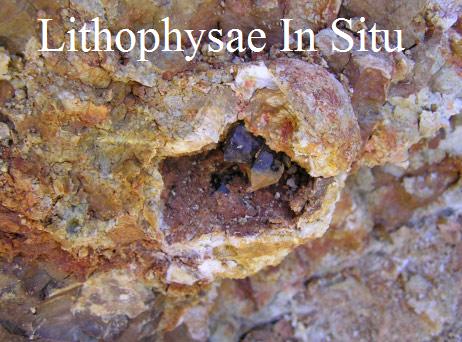
The clay is derived from an Eocene rhyolite flow. Over the past 40-odd million years, the rhyolite has decomposed to clay. The smoky quartz crystals formed in lithophysae, aka: thundereggs. The clay shows the sub-horizontal banding of the original rhyolite, and varies from a moist, elastic, dense medium that sticks to your shovel, to a hard adobe like substance. Depending on recent rainfall, the hole starting process can take from a day to a week.

Once you dig through the surface clay, the material becomes more uniform. About 5 ft. down is a red clay zone that marks the beginning of the lithophysae-bearing area. Fossicking areas require that only hand tools be used, so we set up a hand-powered rope windlass to haul the muck out of our hole. As the hole deepens, more time is required to remove each round of waste. In a week we were down 10 ft; by the end of the second week, 16 ft. Muck leaves the hole by windlass. An hourʼs digging in a 10 X 10 ft. hole requires 20 minutes of hoisting buckets.

As we continued down, we encountered layers where lithophysae were abundant. Collecting crystals is a lot slower than digging clay, so our downward progress slowed. The third week we only dug 4 ft. of muck, but produced over a thousand crystals. Every evening we cleaned our daily take of ʻeggsʼ, at least enough to judge the quality of the crystals found.

During our third week, we struck a layer of large eggs, up to a foot in diameter. Eggs this large are uncommon at Mooralla. In the photo, you can see the normal-sized
eggs (+/- 3 inches) in the pink clay band above, with the larger eggs below in the grey clay horizon. The pick head is 10 inches. At least 50% of the smokies are double terminated. Fast growth (vapor phase) caused frequent inclusions and enhydros to form within the crystals.

It is hard to imagine how the crystals formed in these lithophysae, as they are so densely packed there is little room for the clay. Almost every egg, even tiny ones, will have at least one smoky, usually sitting on a bed of small, clear quartz druse. Larger eggs will contain multiple plates of smokies attached to thin shells of silicified rhyolite. Opening a large egg is like peeling an onion.

That week I returned to Melbourne to pick up a group of visitors from the U.S. & Canada; they had the experience of digging out one egg after another. When the eggs are widely separated, it is easy to pop them out with a deft swing of a pick, but when they are tightly packed, much delicate work is required to avoid damaging the crystals.

During our 4th week, the rainy system that had caused floods in Queensland reached Victoria. Working the hole in the rain is normally no problem, as the large tarp shunts the water away from the hole. Walking between camp and the hole can be an adventure, as the clay ground surface is extremely slick, and your boots quickly accumulate many pounds and inches of gooey clay.

After 3 days of nearly-continual rain, we decided that maybe a visit to town was in order. The access to the locality requires fording two creeks, normally dry in November. The first time I looked, there were 6 inches of water in the creek. The second time, 2 hours later, the creek was 18 inches deep and moving quickly. Since my flight home was scheduled later that week, it seemed a good idea to make a run to town. Was glad we did, as 2 days later our camp area was submerged. The zone in the bottom of the hole was encouraging, weʼll return to dig it back out another year.
-Bob Jackson

Wednesday, March 9, 2011

More Photos From the Nuevo Silica Mine


Here are a few more photos from the Nuevo Silica Quarry that I couldn't quite fit into the original articles but I think are worth posting anyway. One of the most striking things about the mine was the huge tourmaline sprays, but their true size was difficult to properly capture on film. The camera likes to make things look smaller than they really are. In the top photos, you can see several more of the interesting fan shaped patterns that some of the tourmalines formed in the host rock.

The photo to the right captures Sesame Pooch observing one of the areas were the tourmalines looked like splattered and dribbled black paint. The bottom left photo shows some of the water clear quartz and black tourmaline pieces that I took home with me (click the photo for a larger view).

There was also one nice piece of smokey quartz, but I actually didn't spend much time collecting as I was so busy exploring and taking pictures.

The first part of the story, In Search of the Nuevo Silica Mine, is here. The second part of the story, Finding the Nuevo Silica Mine, is here.

Thursday, March 3, 2011

Finding the Nuevo Silica Mine


The next day dawned cool and crystal clear, the lingering rains now swept away by a perfect day. We started well before lunch with Dave sporting more research on the location and a much better photo from Google Earth. His plan? He wanted to try coming at the mine from a whole 'nother direction, this time further North. He had seen the mine on Google Earth and felt we had been close to it the day before, but that there looked to be better roads coming in from the other side. So we drove along another paved road for a long time and then by chance, spotted an offroad vehicle turning off the main road in front of us. In a split second, Dave decided to veer and follow. We had no idea where this dirt road would lead but it was going in the right general direction.

The area turned out to be an offroad mecca, with substantial moguls and side roads built up in many places. We crawled along for some time, attempting to head towards the power lines ahead, which Dave knew from Google Earth were near the mine. At one location, gold colored mica was so thick on top of the road that the road literally looked clad in gold. I tried to take a picture of it but unfortunately, the camera could not properly process the gold color and the picture only appeared to show a shiny wet road.

At several places, recent heavy rains had substantially eroded the road, and at one point, just inches from high centering, we had to stop and fill in some of the ruts before moving on. In the first photo, you can see Dave, who was supposed to be filling in the last part of the rut, as he gets distracted by a pretty rock and has stopped to inspect it. I guess you just can't keep a rockhound away from the rocks! Just before that, I had been collecting large rocks to throw into the ruts, when I unknowingly grabbed a rock that was covered in fire ants underneath. Cluelessly carrying it along, it was not until I reached the ruts that all the ants collected on my hand simultaneously bit me. How they can synchronize like that is beyond me! The lesson for me is to pay more attention to my environment.

Eventually, we were on our way again only to stop again shortly to follow a long skinny strip of pegmatite banding. Again, we saw white quartz with pinkish feldspar. I walked for at least a half hour, following the white lines, but not finding anything quite worthy enough to become excited about. But I couldn't quite get myself to stop following those amazingly straight lines in the ground! Any minute, the pegmatite might improve and I might find some garnet or tourmaline! Or so I kept telling myself as I walked until finally running out of white lines and returning to the truck. While I was gone, Dave had spent some time digging into the dyke closer to the truck, but he also had founding nothing of interest, just some tiny ends of what he called 'red tourmaline' but what I thought were probably tiny dark red garnets squished into the host rock. [Edited to add: Looks like these may in fact really be zircon] We continued on, choosing roads, and then sometimes backtracking and unchoosing those same roads, but always mostly heading towards the power lines.

Until finally up ahead, we saw chunks of broken ice lining the road. Or was that actually quartz!?! (see 2nd photo closeup) I was so eager, I jumped out of the truck before Dave even had time to park. I could see hoards of white and clear quartz and even the occasional black tourmaline interspersed between. We knew we had to be near to something because where had all these broken chunks of rock come from? They were clearly tailings, and just up ahead, Dave saw the entrance to the quarry (3rd photo), well hidden until you were right on top of it, a cut out area beyond which was a short but steep trail into the open mine pit below. We had found Nuevo Silica mine!

At the top of the quarry, long black veins of compressed mica ran along the walls. But the most striking part were the huge black tourmalines embedded lower down in the mine, directly in the rock walls, many of them as big as my arms (4th photo, note the rockhammer for perspective, and 5th photo). More pressure lower in the mine had grown tourmalines instead of mica veins. The tourmalines made a variety of shapes in the walls including parallel lines, fans, bullet like blobs formed from an end on view, and even in some places, meandering lines as if black paint had been splashed against the walls. The walls were steep and in many places, deep pockets had been dug into the walls, but Sesame Pooch easily danced up the sides using tiny footholds that only a dog could find. In a corner of the mine, Sesame also found a small 'short cut' tunnel that also led out of the mine (6th photo just above) We spent considerable time investigating and collecting bits of black tourmaline, until Dave found another hole in the ground further away.

This time, the hole was a horizontal tunnel instead of an open pit. Sesame was the first to inspect the mine entrance in the 7th photo (to the right). We speculated the goal of this mine may have been gold instead of silica. The tunnel disappeared far into the Earth, but water dripped from the ceiling, the floor of the tunnel was heavily flooded and even the entrance was incredibly slippery. (8th photo just below/left)

We contemplated wading further in, as the water did not appear high, but on thinking about it, we realized the murky grey water could have hidden a vertical shaft or any matter of other hazards, making for a potentially dangerous situation. Besides that, neither of us had brought an extra pair of shoes! So we decided sometimes discretion is the better part of valor and moved on. Perhaps later in the spring, when the water table drops. this shaft may become more easily accessible. However, near the entrance to this tunnel, in its tailings, we did find the most clear of all the quartz pieces we found that day, many of them, although not large, were water clear and suitable for faceting.

After more collecting, we headed out along more off road moguls and bumps back towards the main road. Since we still had a little bit of time before absolute dark, Dave, not wanting to waste any of our time up there, decided to go further down the paved road and looked for additional access points, perhaps some that might be less difficult and bumpy. Eventually, after many dead ends, we did find another road that went through, this one much further East. We followed it up directly to the power lines, the ruts here also being difficult in a few places. At the top, we found a thick pegmatite dyke running right under one of the power line foundations! More pinkish feldspar was there to be found. And on we went, our shadows now very long indeed and then next thing we knew, we were crossing another road, this one a very nice new paved one. Where had this one come from!?! We had not seen any paved roads previously but we were still far from the mine.

Whatever the case, we followed it and found it was another road that we had looked for fruitlessly the day before. We even saw pegmatite vein running right through the road! (last and 2nd to last photos) This vein also contained some black tourmaline but all the pieces I saw were locked inside the host rock. But eventually we could barely see, it was so dark, so we headed back down hill to find out where this paved road connected to the roads below. At the end, we found this road was actually blocked by a gate, which is why we had not found it the first time. Google Earth didn't tell us about the gate! ;-P The gate would allow people out so we could leave this night, but getting in would have required the password or a clicker code, neither of which we had. Anyway, it was dark now, so the rest of that road and its side roads will have to be an adventure for another time. But we found our mine and we found an heretofore unknown and ungated path to that mine. We found a prodigious supply of black tourmaline and water clear quartz and we avoided getting seriously stuck numerous times, so not bad for a day's work!

{You can see part one of this adventure here: Rockchaser: In search of The Nuevo Silica Mine}
For additional pictures of the mine, click here.

Monday, February 28, 2011

In search of The Nuevo Silica Mine


We left at 2PM on Saturday, a last minute decision to scout the area around Nuevo to look for the Nuevo Silica quarry. The mine was reportedly located behind a road that had recently been taken over by a church. One thing we needed to ascertain was if
the church was allowing traffic to the mine. Rumor had it that a gate at the church was intermittantly opened and closed, thus causing a constant hazard to access to the mine. One of our numerous goals that day was to find a route that would bypass the church altogether. But doing that without even knowing the exact location of the mine itself would prove to be tricky.

First we drove along the base of the mountain, looking for any and all roads that headed in the right direction, but all were blocked off by gates or recently built
houses. Eventually, we realized we had little choice but to hazard the church route and were soon back at the road to the church (can't remember if there was a gate there or not!) that gave us access to a meandering dirt road until finally, ahead, we could see some structures and parked cars. Not sure what kind of reception we would get, we decided to take an alternate branch of the road that led into the hills to the left, instead of going directly past the church itself.

This side road meandered in endless spirals and cloverleaf patterns, the off roaders had obviously had some fun in that area. As we drove, the rocks slowly changed from rounded off on top to sometimes twisted and tortured shapes of nightmare. The lava here had indeed suffered before dieing but now it was reaching out even after death(2nd photo)! Other granitic rocks had large off colored bumps that looked like plague skin lesions (1st photo). One rock even looked like a weary petrified buzzard (second to last photo).

But despite the eery rocks, the area here was indeed beautiful, the artistic rocks interspersed with soft green winter grasses and white flowering bushes. The soft soil and smooth rocks also happen to be Sesame Pooch's favorite kind of environment to run wildly hither and yon, barely able to decide where she should run towards next. She trounces happily in photo 4, until in photo 5, you can see where Sesame Pooch is actually being eaten by a giant killer dog eating head chomping rock! (click on the photo to see a larger view) ;-P


As we drove and intermittantly parked and wandered, Dave told me a lot about pegmatite dykes and how they formed, most of which I have now totally forgotten! But he did assure me that the area looked promising and indeed, we did find some streaks of white rock in one area which was a pegmatite dyke running along the ground. Inspecting the white rock, we found a lot of white quartz along with some pinkish feldspar and the occasional black tourmaline. We also found an area where several large rock faces had weird indentations like the fingers of God had been poking and probing at His Playdough creation (3rd photo).

But it was getting late and Dave wanted to try a new way out, down hill instead of back up towards the church. Luckily, we soon found yet another branch of dirt road that lead in the right direction, and as we followed it, it looked more and more commonly used, always a good sign when you are hoping your road will pan out.

Soon it was already dark as we continued to pick our way along strange roads, but we knew we were almost back to the main road and eventually we did make it. At one point, we encountered one of the roads we had looked for desparately on the way in but could not find! But at least we now knew of a way into the area without going
through the church. Or did we? First and most important, was that really the route to the Nuevo Silica mine? Since we had not actually found the mine itself, we still could not say for sure. The second question was, even if it was the right route,
after all that meandering, did we even stand a chance of finding the same route twice? Both questions would soon be answered in spades by the end of day two, which will be the next posting. But as a coming attraction, I give you the bottom photo. Hint: the big black spots are big black tourmalines! (Plus it looks like Sesame Pooch actually survived her encounter with the killer dog eating rock after all!)

To see part two, "Finding the Nuevo Silica Mine" click here.
For additional pictures of the mine, click here.